













 Maternity: Antenatal care, labour and delivery, postnatal and newborn records
+$38.40/mo at 20 practitioners. Free instant access, no credit card required.
Works with
 Wards & Inpatient
What's inside
Everything in Maternity
47 items in 8 areas, every one shipping with the app today.
Pregnancy Episode (OB Case)
- One record per pregnancyA central Obstetric Case ties every ANC visit, partograph, delivery, baby, postnatal visit and PMTCT record to a single pregnancy episode.
- Auto-numbered case referenceEach pregnancy gets a unique sequence-generated reference (OB/...) on creation for easy tracking and reporting.
- Female-only patient linkagePatient selection is domain-restricted to female/
other/ unknown gender records to prevent mis-registration. - Automatic EDD from LMPExpected Date of Delivery is computed by Naegele's rule (LMP + 280 days) and remains editable after a dating scan.
- Live gestational age & trimesterGestational age in weeks+days and current trimester (first/
second/ third/ post-dates) are computed continuously from LMP versus today. - G/P/A/L parity trackingGravida, Para, Abortions and Living children are captured and shown as the standard GPAL parity summary.
Antenatal Care (ANC)
- Focused ANC visit recordsEach antenatal contact is a tracked record attached to the pregnancy with auto-numbered reference and visit date.
- Auto-counted visit numberThe 1st/2nd/3rd ANC visit sequence is computed automatically from preceding visits on the same pregnancy.
- Per-visit gestational ageGestational age at the visit date is auto-computed from the pregnancy's LMP.
- Maternal vitals captureWeight, systolic/
diastolic BP, temperature and pulse are recorded and tracked each visit. - Fetal assessmentFundal height, fetal heart rate, presentation, engagement and fetal movement are documented per visit.
- Urinalysis & hemoglobinUrine protein and glucose dipstick grades plus hemoglobin (g/
dL) are captured for pre-eclampsia and anemia screening.
Labor Monitoring (Partograph)
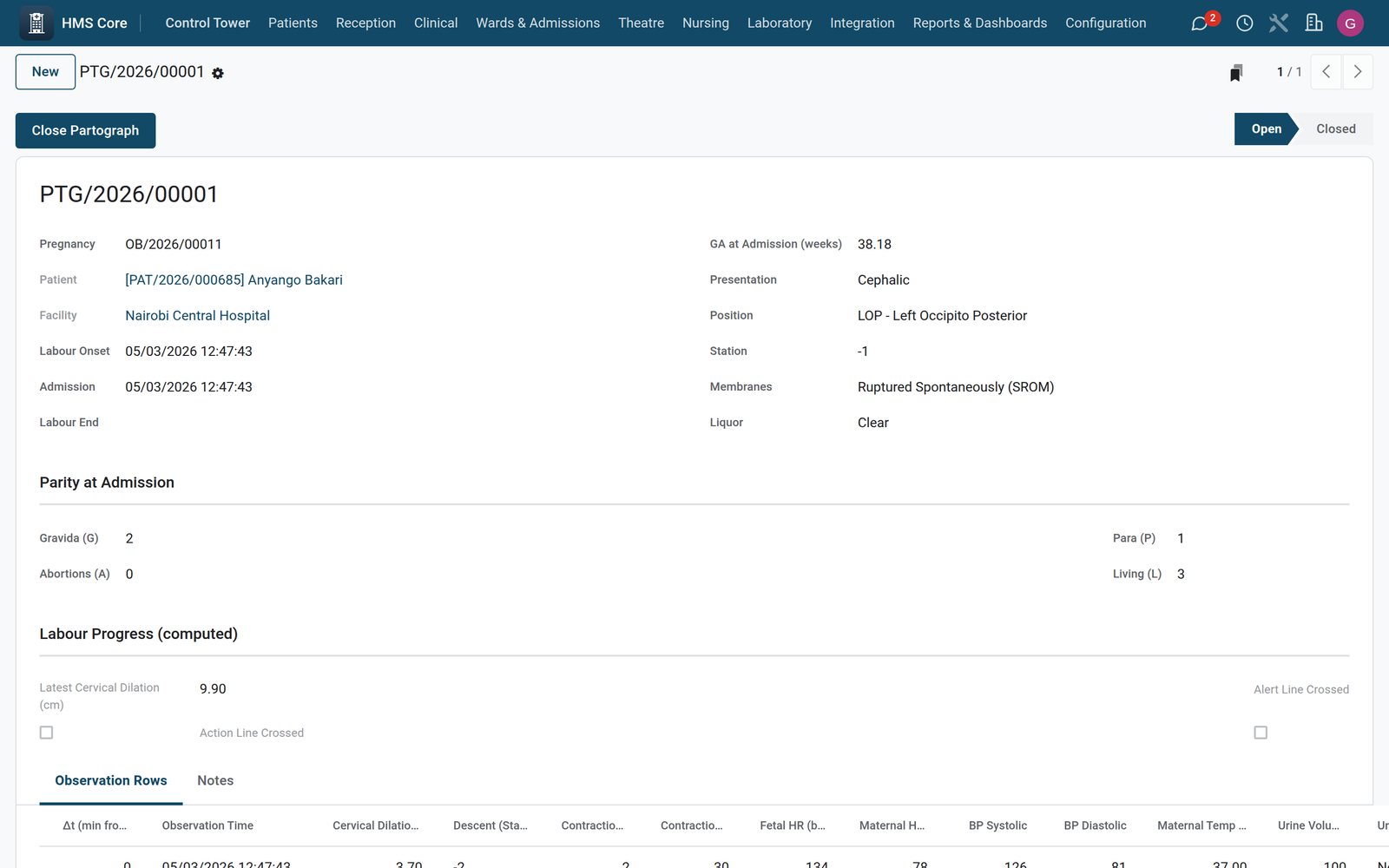
- Electronic WHO partographA labor partograph header captures onset, admission, parity, gestational age and presentation for active-phase monitoring.
- Timestamped observation rowsEach partograph carries multiple time-offset observation lines computed to real clock times from labor onset.
- Cervimetry & descent plottingEvery row records cervical dilation, fetal descent station, contraction frequency and duration.
- Maternal & fetal parameters per rowFetal heart rate, maternal pulse, BP, temperature, urine output/
protein, oxytocin rate and drugs are logged over time. - Automatic alert-line detectionThe system computes whether plotted dilation crosses the WHO alert line (1 cm/
hr expectation) and flags it. - Automatic action-line detectionA greater lag triggers an action-line-crossed flag signaling the need for intervention.
Delivery & Labor Outcome
- Delivery event recordsEach birth is captured as a tracked, auto-numbered delivery linked to the pregnancy, supporting twins/
multiples. - Mode of deliveryRecords SVD, vacuum, forceps, elective/
emergency C-section or breech vaginal delivery. - C-section indication enforcementAn indication is mandatory whenever the mode is a caesarean, enforced by constraint.
- Perineal trauma gradingEpisiotomy type and perineal tear degree (1st through 4th) are documented.
- Third-stage & placenta managementAMTSL/
expectant/ manual placenta delivery, placenta completeness and prophylactic oxytocin are recorded. - Blood loss & PPH auto-detectionEstimated blood loss auto-flags postpartum hemorrhage against mode-specific thresholds (500ml SVD / 1000ml CS).
- Delivery event recordsEach birth is captured as a tracked, auto-numbered delivery linked to the pregnancy, supporting twins/
Newborn (Baby) Registry
- Newborn baby recordsEach live or stillborn baby is registered with sex, birth date/
time and twin/ multiple birth order. - Anthropometry & APGARBirth weight, length, head circumference and APGAR at 1/5/10 minutes are captured per baby.
- Resuscitation recordLevel of resuscitation from none through stimulation, bag-mask, intubation, compressions and drugs is documented.
- Birth-dose immunizationBCG, OPV-0, Vitamin K and eye prophylaxis administration are tracked for each newborn.
- Early breastfeeding indicatorRecords whether breastfeeding was initiated within the first hour of life.
- HIV-exposed / EID flagAn HIV-exposed flag marks infants requiring early infant diagnosis follow-up.
- Newborn baby recordsEach live or stillborn baby is registered with sex, birth date/
Postnatal Care (PNC)
- Postnatal visit recordsPNC contacts are auto-numbered records tracking maternal recovery after delivery.
- Automatic PNC milestone classificationDays postpartum is computed from the delivery date and mapped to a 6h/6d/6w/6m postnatal schedule, Kenya MoH's by default.
- Maternal recovery assessmentBP, temperature, pulse, lochia type, uterine involution and perineal/
wound healing are documented. - Breast & feeding evaluationBreast problems (engorgement, mastitis, abscess) and feeding method (exclusive/
mixed/ formula/ weaning) are recorded. - Postpartum family planningContraception method chosen from a full menu (implant, IUD, injectable, BTL, LAM and more) is captured.
- EPDS depression screeningEdinburgh Postnatal Depression Scale score is recorded with a 0-30 validity constraint.
PMTCT Cascade
- Structured PMTCT recordA dedicated cascade record tracks prevention of mother-to-child HIV transmission per pregnancy.
- Maternal HIV testingHIV testing and results in both ANC and Labor & Delivery are captured to catch seroconversion.
- Maternal ART trackingART initiation, start date and regimen (TDF+3TC+DTG and alternatives) are documented.
- Infant ARV prophylaxisInfant prophylaxis regimen (NVP 6/12 weeks, AZT+NVP high-risk) and start date are recorded.
- Early Infant Diagnosis milestonesEID testing at 6 weeks, 9 months and 18 months with dates and results is tracked through the cascade.
- Infant feeding choiceExclusive breastfeeding, replacement or mixed feeding choice is recorded per PMTCT guidelines.
Configuration Catalogs
- Obstetric risk factor catalogA configurable, translatable master list of risk factors with severity, code and description, seeded with WHO-aligned entries.
- Rich seeded risk libraryShips pre-loaded conditions such as previous caesarean, multiple gestation, pre-eclampsia, placenta praevia, IUGR and grand multiparity.
- Complication catalogA configurable complications master list categorized by phase (antenatal/
intrapartum/ postpartum/ neonatal) and severity. - ICD-10 coding on complicationsComplications carry optional ICD-10 and internal codes with unique-code enforcement for standardized reporting.
- Manager-gated configuration menuRisk factor and complication maintenance sit under a Configuration menu restricted to Obstetrics Managers.
Works with
What Maternity works with
Maternity shares one database with the rest of the Bridge HMS Suite and BridgeERP: these are the apps it already talks to, with nothing to buy in between.
Builds on
Maternity needs these to run; they come with it in the same plan.
And the wider platform
Any BridgeERP app can join the same database.
 AccountingFull double-entry accounting, bank reconciliation, assets, budgets and statutory reports.
 ExpensesEmployee expense claims with receipt capture and reimbursement.
 InvoicingCustomer invoices, vendor bills, payments and tax handling.
 SignSend documents for legally binding electronic signature.
 SubscriptionsRecurring contracts, automatic renewals and MRR reporting.
 EmployeesEmployee records, contracts, attendance, skills, appraisals and referrals.
In the suite
More Bridge HMS Suite apps
 HMS Core
 Reception
 Appointments
 Consultation / OPD
 Electronic Health Record
 Laboratory
 Pathology
 Radiology & PACS
 Pharmacy
 Billing & Cashiering
 Insurance & Claims
- Wards & Inpatient
 Nursing
 Operating Theatre
 Intensive Care
 Emergency
 Blood Bank
 Dialysis
 Paediatrics
 Dental
 Ophthalmology
 Specialty Packs
 Telehealth
 Patient Portal
 Ambulance
 Mortuary
 Medical Stores
 Dietary
 CSSD
CSSD Infection Control
 Quality & Accreditation
 Health Analytics
 Bria Clinical AI
 Interoperability
 Public Health
 Country Compliance
 Biomedical Engineering
 Facility Helpdesk
 Housekeeping
Put Maternity to work
Add it to your Bridge HMS Suite plan, priced per practitioner, or start a free trial and see it running first.