













 Emergency: Casualty triage, resuscitation records and emergency dispositions
+$38.40/mo at 20 practitioners. Free instant access, no credit card required.
Works with
 HMS Core
What's inside
Everything in Emergency
74 items in 13 areas, every one shipping with the app today.
Arrival & Registration
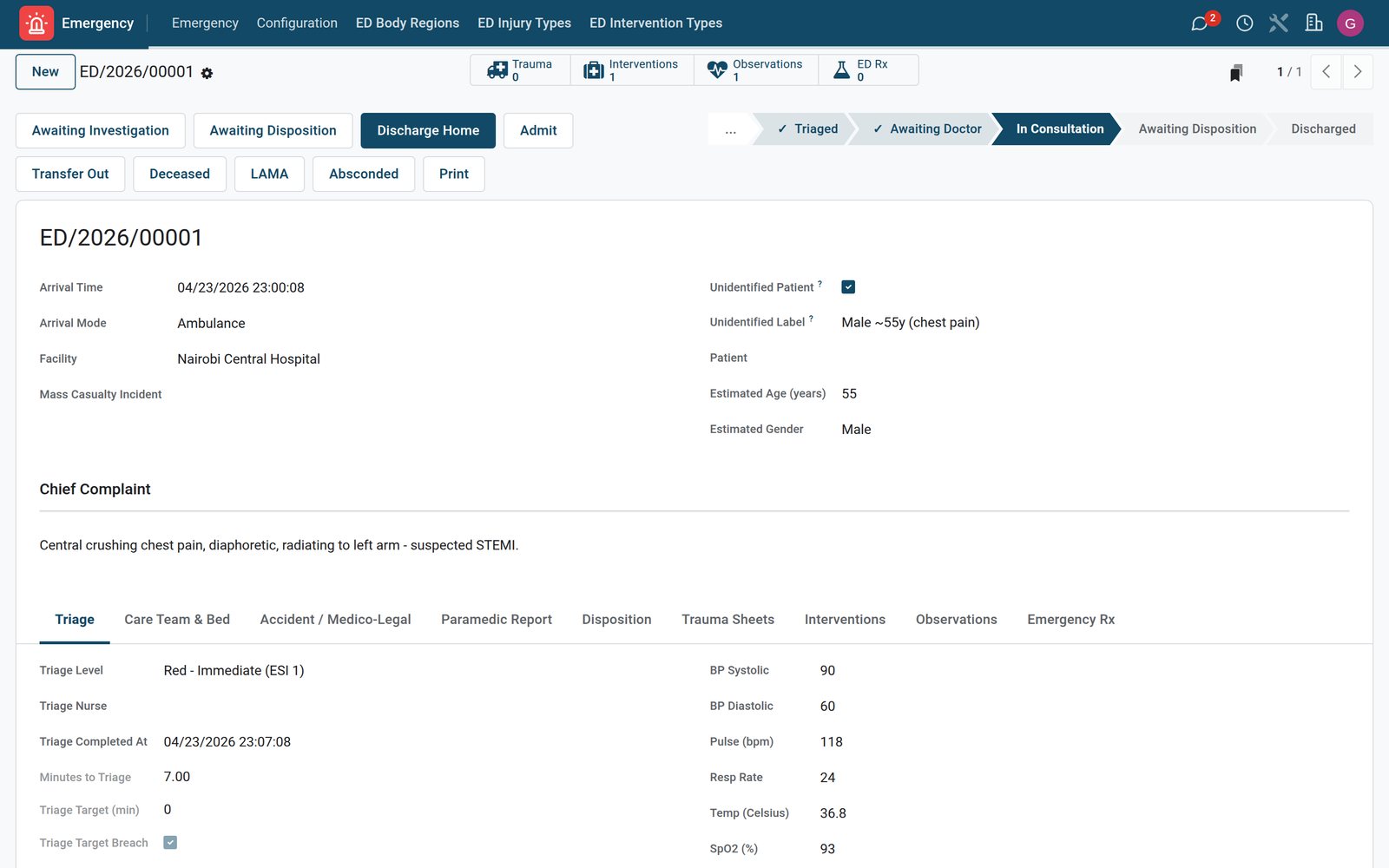
- Rapid ED Arrival RegisterCentral emergency arrival record with auto-sequenced arrival number, timestamp, chief complaint and full mail chatter tracking.
- Seven Arrival ModesCapture how the patient arrived: walk-in, ambulance, private vehicle, police vehicle, wheelchair, helicopter/
air ambulance or referred facility. - Unidentified John/Jane Doe HandlingRegister unconscious or unknown patients with estimated age, gender and a short whiteboard label until identity is established.
- Ambulance Receiving WizardPre-hospital handover screen capturing unit ID, ETA, ATMIST report, provisional triage and accident flags, creating the arrival in one step.
- Paramedic / Pre-Hospital ReportRich-text ATMIST/
MIST field storing the ambulance crew's pre-hospital handover on each arrival. - Referral Source CaptureRecords referring facility and referring doctor for inter-facility transfers.
Triage & Whiteboard
- Five-Level ESI TriageColor-coded triage levels Red (ESI 1), Yellow (ESI 2), Green (ESI 3), Blue (ESI 4-5) and Black (dead on arrival).
- Rapid Triage WizardOne-screen triage tool that sets level, nurse, vitals and ED bed, then advances the arrival state and occupies the bed automatically.
- Color-coded Live Whiteboard KanbanKanban board grouped by ED bed with red/
yellow/ green/ blue/ black color badges reflecting each patient's acuity. - Triage Latency & Target Breach TrackingAuto-computes minutes-to-triage against per-level targets (Red 0, Yellow 10, Green 30, Blue 60 min) and flags breaches.
- Quick Triage-Level MenusDedicated menu shortcuts to filter the board to Red, Yellow, Green, Today's, or all arrivals.
Trauma Documentation & Scoring
- ABCDE Primary Survey SheetStructured Airway/
Breathing/ Circulation/ Disability/ Exposure documentation with airway intervention choices, oxygen, fluids and cap-refill. - Glasgow Coma Scale CalculatorEye/
verbal/ motor GCS selectors auto-summing to a GCS total on the trauma sheet. - Revised Trauma Score (RTS)Automatically computes the coded RTS from GCS, systolic BP and respiratory rate using standard weighting coefficients.
- Injury Severity Score (ISS) with CategoryDerives ISS from top-three body-region AIS values (squared-sum, AIS-6 capped at 75) and classifies minor through unsurvivable.
- TRISS Survival ProbabilityOn-demand blunt-trauma TRISS calculation combining RTS, ISS and patient age, posting the survival percentage to the chatter.
- Injury Inventory by Region & TypeTag injured body regions and injury types (mechanism, baseline severity) via seeded catalogs to drive scoring.
- ABCDE Primary Survey SheetStructured Airway/
Interventions & Observations
- Intervention LogTime-stamped record of every ED procedure with performer, dose/
parameters, outcome and complications. - Double-Signature for Life-Saving ProceduresEnforces a distinct witness signatory on high-risk interventions flagged as requiring double sign-off, blocking self-witnessing.
- Hourly Observation ChartSerial nursing observations of vitals, GCS, mental state, urine output, fluid intake and treatment response over the ED stay.
- Automated NEWS2 ScoringEach observation auto-computes the National Early Warning Score 2 from respiratory rate, SpO2, temperature, BP, pulse and consciousness.
- Seeded Intervention Catalog34 pre-loaded ABCDE-categorized interventions (oxygen, defibrillation, intubation, CPR, thrombolysis, chest decompression) with billing codes.
- Intervention LogTime-stamped record of every ED procedure with performer, dose/
Emergency Prescriptions & Billing
- Save-Life-First Retrospective RxRecords emergency medications given (drug, dose, route, indication, administrator) before any paperwork, deferring billing.
- Retrospective Prescription Back-FillRetro-billing builds a proper emergency prescription and line on the visit, then raises the charge, keeping records complete.
- Intervention Charge CaptureTurns billable interventions into hospital charges using the type's billing code and default cost, linked back to the source record.
- Medication Product ValidationBlocks prescribing products not flagged as medications in the product catalog.
- Automated Retrospective Billing CronsTwo scheduled jobs auto-bill unbilled emergency medications and completed interventions once the arrival reaches a terminal state.
Disposition & Downstream Automation
- Full Disposition WorkflowDischarge home, admit (general/
ICU/ HDU/ theater), transfer out, mortuary, left-against-advice or absconded, each with its own guarded action. - Auto-Admission CreationAdmitting from the ED auto-creates an inpatient admission of type emergency via the ER route, linked to the visit and doctor.
- Auto Follow-Up AppointmentDischarging home auto-schedules a follow-up appointment seven days out for the patient.
- Auto Mortuary IntakeMarking a patient deceased auto-generates a mortuary intake record with death date and cause reference.
- ED Bed Auto-ReleaseFrees the occupied ED bed to a cleaning state when a patient leaves the department.
- Clinical Visit BridgingAuto-creates and advances a linked emergency clinical visit (triage, consultation) as the arrival progresses.
- Full Disposition WorkflowDischarge home, admit (general/
Medico-Legal & Accident
- Accident Case CaptureFlags accident cases with ten types (RTA, assault, burn, fall, poisoning, drowning, electric shock, industrial, animal, other) and description.
- Police / Medico-Legal WorkflowCaptures police OB number and station for medico-legal cases and blocks disposition until an OB number is recorded.
Mass Casualty Incident (MCI)
- MCI Activation WizardOne-screen incident activation capturing type, location, county, estimated casualties, commander and first-wave triage tally.
- Eleven Incident TypesClassify incidents: multi-vehicle RTA, explosion, fire, building collapse, stampede, chemical spill, biohazard, shooting, disaster, outbreak, other.
- Live vs Estimated Triage TallyTracks manual first-wave red/
yellow/ green/ black estimates alongside auto-computed live counts from actual linked arrivals. - MCI Command State MachineActivated to In-Progress to De-Escalating to Resolved lifecycle with duration tracking and incident commander assignment.
- External Agency CoordinationLinks responding agency partner contacts and records agency codes (Red Cross, Police, Fire, KDF, MoH and more).
- Resource Deployment & SITREPFree-form resource-deployed log plus a rich-text situation report on each incident.
Configuration
- Settings
Emergency
- ED Dashboard
- Red
- Active
- ED Whiteboard
- Yellow
- History
- Green
- Activate MCI
- Today
- Rapid Triage
- All Arrivals
- Ambulance Receive
- Trauma Docs
- Interventions
- Emergency Rx
- Observation Charts
- Handovers
- ED Body Regions
- ED Injury Types
- ED Intervention Types
Documents it prints
- ED Arrival Summary
- Trauma Sheet
- MCI Situation Report
- ED Whiteboard Snapshot
It runs by itself
- HMS ED: Alert stale arrivals (>4h)Runs hourly
- HMS ED: Retrospective emergency Rx billingRuns hourly
- HMS ED: Retrospective intervention billingRuns every 2 hours
- HMS ED: Auto-resolve stale MCIs (>24h)Runs every 6 hours
Guided assistants
- Rapid ED Triage Wizard
- MCI Activation Wizard
- Ambulance Receiving Wizard
- Config Settings
Works with
What Emergency works with
Emergency shares one database with the rest of the Bridge HMS Suite and BridgeERP: these are the apps it already talks to, with nothing to buy in between.
Builds on
Emergency needs these to run; they come with it in the same plan.
And the wider platform
Any BridgeERP app can join the same database.
 AccountingFull double-entry accounting, bank reconciliation, assets, budgets and statutory reports.
 ExpensesEmployee expense claims with receipt capture and reimbursement.
 InvoicingCustomer invoices, vendor bills, payments and tax handling.
 SignSend documents for legally binding electronic signature.
 SubscriptionsRecurring contracts, automatic renewals and MRR reporting.
 EmployeesEmployee records, contracts, attendance, skills, appraisals and referrals.
In the suite
More Bridge HMS Suite apps
- HMS Core
 Reception
 Appointments
 Consultation / OPD
 Electronic Health Record
 Laboratory
 Pathology
 Radiology & PACS
 Pharmacy
 Billing & Cashiering
 Insurance & Claims
 Wards & Inpatient
 Nursing
 Operating Theatre
 Intensive Care
 Blood Bank
 Dialysis
 Maternity
 Paediatrics
 Dental
 Ophthalmology
 Specialty Packs
 Telehealth
 Patient Portal
 Ambulance
 Mortuary
 Medical Stores
 Dietary
 CSSD
CSSD Infection Control
 Quality & Accreditation
 Health Analytics
 Bria Clinical AI
 Interoperability
 Public Health
 Country Compliance
 Biomedical Engineering
 Facility Helpdesk
 Housekeeping
Put Emergency to work
Add it to your Bridge HMS Suite plan, priced per practitioner, or start a free trial and see it running first.